Stop Relying on Luck! Become a Smart Detectorist!
Have you ever wondered why some detectorists seem to find amazing treasure all the time, and others just find trash? The secret isn’t magic or luck—it’s data! Enter your field journal – the detectorists secret weapon!
Successful detectorists don’t just hunt; they track their adventures. Your Field Journal (or Treasure Tracker) is the key that transforms your hobby from random fun into a systematic science, turning you into a highly efficient treasure finder!
The Scientific Method in the Dirt
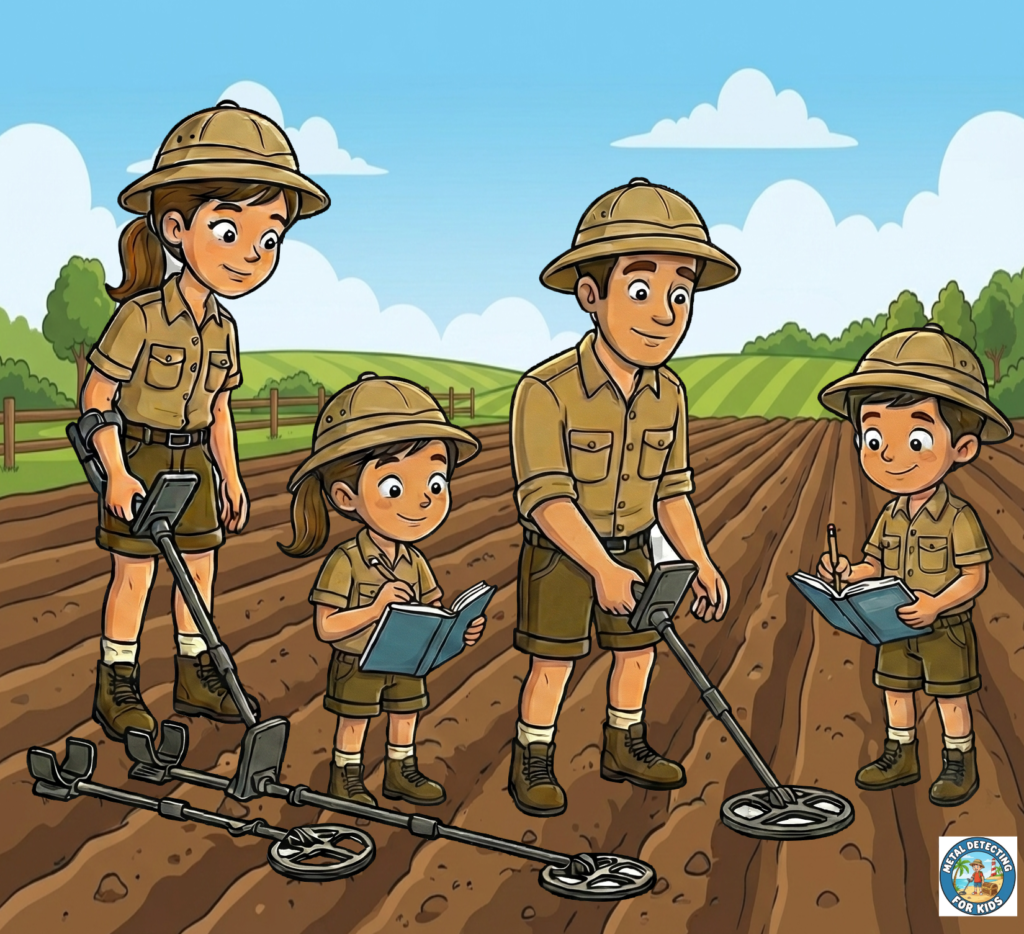
The log book provides you with a real-world laboratory to practice the core principles of science:
1. Observation: You carefully listen to your detector’s signals.
2. Variable Control: You record crucial details, especially your Machine Settings. How deep was the sensitivity? What was the discrimination level? This is the most important step!
3. Analysis: By looking at your log entries later, you can see a direct link between what settings you used and what you found. If a specific setting consistently helped you find small coins at a certain depth, you’ve just identified a “winning strategy”!
This process trains you in pattern recognition. You stop guessing and start using evidence to strategically adjust your thinking, which is a major life skill!
Mastering Data Management in Your Field Journal
Think of your journal as your personal discovery database. It systematically introduces you to organisational skills that are crucial in school and in any future job. You have to organise all kinds of information, including:
- Location Name and GPS Coordinates: This teaches you precision and helps you map your finds back to the physical world.
- Weather and Environmental Notes: You learn how factors like soil moisture or temperature affect your detector’s performance.
- Location Rating: This forces you to be strategic! If you only give a spot one star, you know not to waste time there again. If it gets five stars, you know exactly where to go for your next big find!
By keeping track of all these different data points, you are mastering data literacy and building a documented history of empirical knowledge. You are not just collecting finds; you are managing a personal discovery dataset!
Now that you know how to use science to find more treasure, let’s talk about another secret skill of the pros. Next time, we reveal The Secret Skill of Detectorist Champions: Why You Need to Be Patient!